
In this guide
A class counts to sixteen. Hands mark a pattern, a wave marks a change, and the next “one” brings everyone back together. That small experience opens a useful mathematical question: how can we describe a pattern that keeps returning?
Rhythm, Shape & सम is a practical project on Zalki for Classes 6–8 that connects mathematical thinking with ideas from Kathak. सम (sam, pronounced “sum”) is the first beat of a rhythmic cycle and its point of return. The project uses that return as a starting point for exploring cycles, equal subdivisions, repeated phrases, rotation and reflection.
What teachers can use
The project is organised as three 40-minute lessons. Teachers can follow the sequence or begin with the activity that best fits their learners’ current work.
- Find the cycle: count a sixteen-beat pattern, identify equal groups and describe how the pattern returns to सम.
- Plan the return: build a tihai-inspired classroom ending, repeating a short tapping phrase three times with two counted gaps, and reason about where its final tap lands.
- Explore shape and movement: use direction, turns and reflection to compare positions and explain a geometric pattern.
The interactive tools make patterns visible and let learners test a prediction. The accompanying nine-page teacher pack provides lesson guidance, learner sheets, worked answers and an assessment rubric. Paper-based and seated alternatives help teachers adapt the work to their classroom, available equipment and learners’ participation needs.
Try the opening pattern
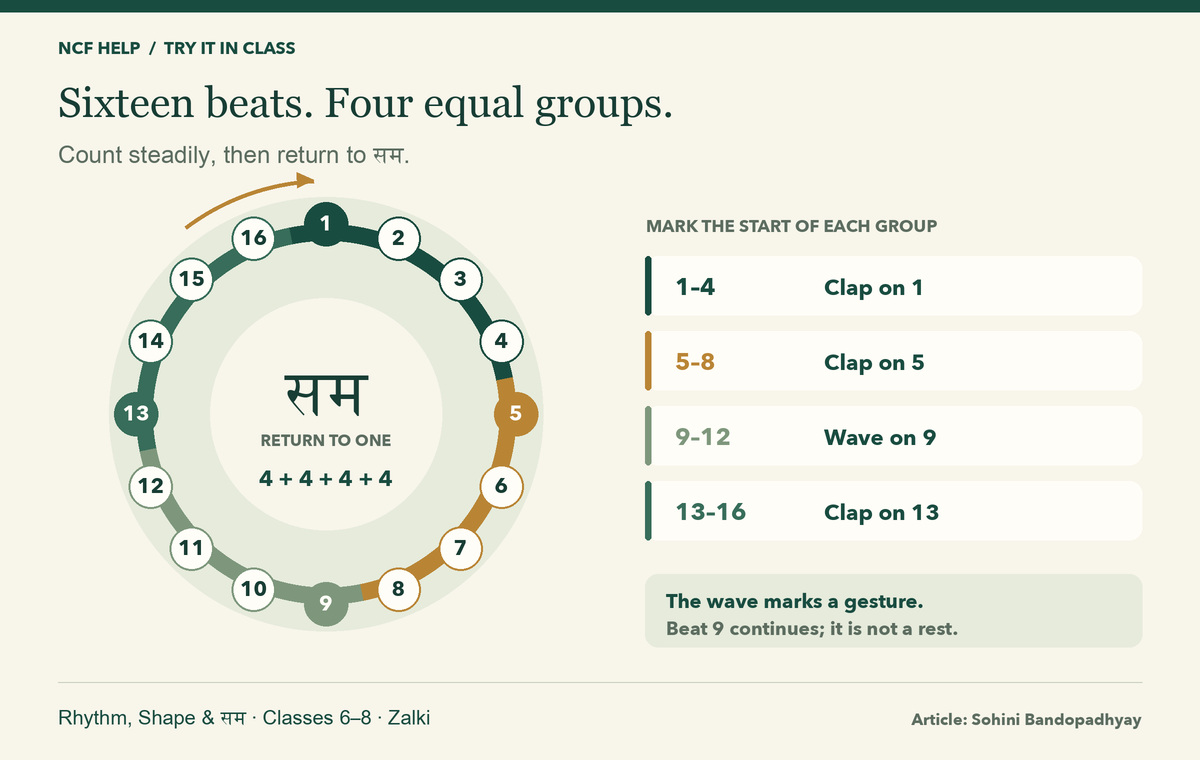
Write 4 + 4 + 4 + 4 = 16 on the board. Count steadily from 1 to 16 together, then return immediately to 1. Mark the first count of each group: clap on 1, 5 and 13; wave on 9. The wave is a gesture within the continuing count; it does not mean that beat 9 is silent or missing.
Repeat the cycle a few times. Learners can use small hand gestures while seated, point to a paper beat grid or follow the count visually. Keep the pace comfortable enough for everyone to notice the grouping and the return.
Then ask: “How many equal groups did we make?” “Which numbered beats start those groups?” “What stays the same when we start the next cycle?” Invite learners to draw a record another group could follow. Comparing their diagrams turns a shared rhythmic experience into mathematical explanation.
Make the reasoning visible
Listen for how learners justify their answers. Can they explain why a grouping fills the cycle? Can they predict a return before trying it? Can they distinguish a turn from a reflection? A clear diagram, spoken explanation or written calculation can all provide evidence of understanding. Dance experience is not required to take part in these classroom investigations.
For a first use, read the opening lesson and print its learner sheet before class. Use the online rhythm tool if a shared screen is available, or begin with the board and paper grid. After the activity, use the worked answers and rubric to decide what learners are ready to investigate next.
Follow the rhythm to Zalki
- Step into the rhythm studio on Zalki — try a beat, build a pattern and see where it leads.
- Read the teacher guide — classroom preparation and the printable teaching sequence.
- Download the nine-page teacher pack (PDF) — lesson plans, learner sheets, worked answers and rubric.
Leave a Reply