
In this guide
Can your class make a rainy morning without a drop of water? A few fingertip taps become the first drops. Palms suggest a shower. Then the rain fades—and everyone holds one quiet beat together.
Try it in Class 3: allow about 35 minutes, in groups of four. Children read a simple visual score, keep a steady pulse, use sound and silence to tell a story, and improve one choice after feedback. You need paper, pencils and space to sit comfortably. Voices and gentle body sounds are enough.
Begin with a minute of noticing
Invite children to listen from their seats. What sounds enter the room? Which are brief, repeated or continuous? Accept descriptions such as “a soft scratch” before naming the source. A child can point, draw or describe a remembered sound instead of identifying it by hearing alone.
Choose three comfortable sounds together: tap fingertips gently into the other palm; rub the palms briefly together; pat a hand softly on a thigh. Agree that each word means one short action. Practise a visible stop signal, such as the conductor closing a hand.
Give silence its own beat
Count “one, two, three, four” at a comfortable walking pace. Keep that pace while pointing to four boxes drawn on the board. Put tap, rest, tap, rest in the boxes. Everyone taps on one and three, staying quiet on two and four.
A rest is a quiet beat, not a missing beat. The pointer keeps moving through it at the same pace. If the group rushes across the empty sound, return to pointing and counting before adding the taps.
Explain that a score is a set of instructions for performing the piece. Here it uses ordinary words and boxes. It is not a mark awarded to a child.
Try a rainy morning in sixteen beats
The score below has four story moments. Read across each row from beat one to beat four, then move straight to the next row. Each row lasts four beats, so the whole piece lasts sixteen. The pulse stays steady when the sound changes.
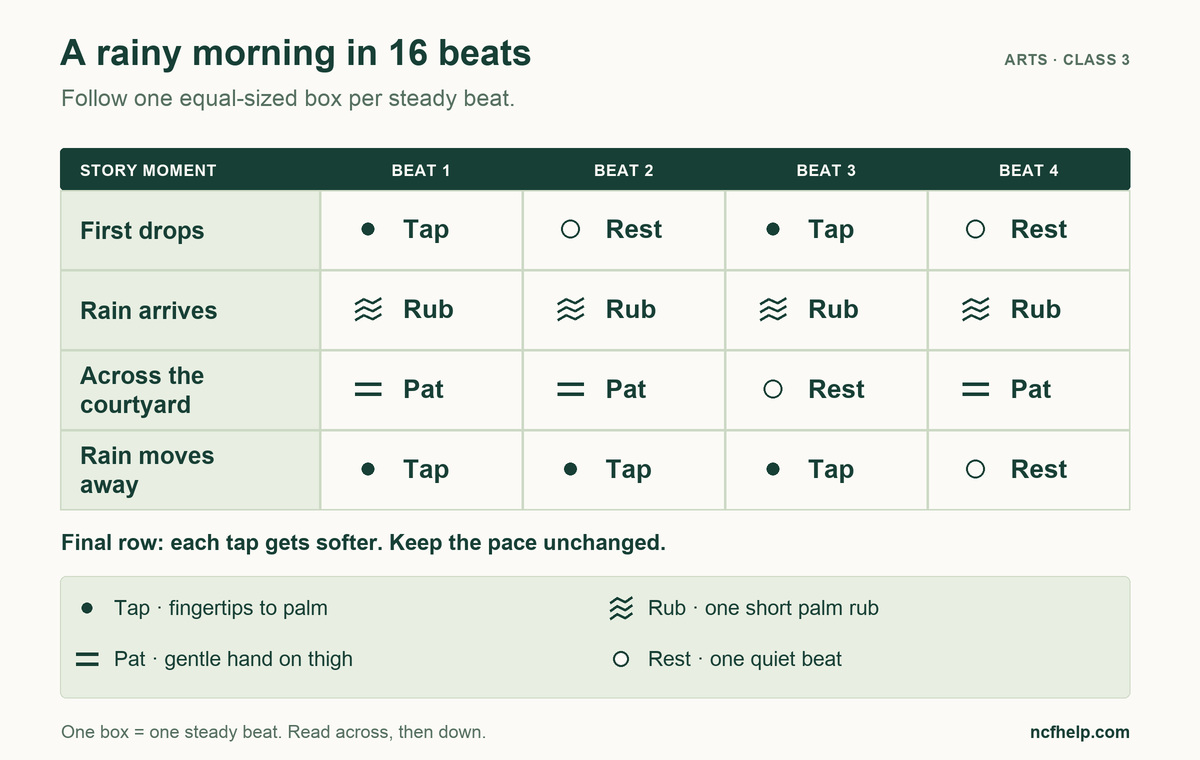
| Story moment | Beat 1 | Beat 2 | Beat 3 | Beat 4 |
|---|---|---|---|---|
| First drops | Tap | Rest | Tap | Rest |
| Rain arrives | Rub | Rub | Rub | Rub |
| Across the courtyard | Pat | Pat | Rest | Pat |
| Rain moves away | Tap | Tap | Tap | Rest |
Start the first row softly. In the second row, make one short rub on each beat. Use gentle pats for the footsteps. In the last row, make each tap softer than the previous one. Hold its final rest for a full beat, then show the stop signal.
A conductor can point to the boxes while the others perform. Count aloud during the first rehearsal, then try with visible cues. A quiet movement, pointing or tracing the pulse can replace a sound-making action. Agree the meaning of that choice before performing.
Let the group change the story
After trying the starter, give each group a fresh four-by-four grid. Invite one change: move a rest, replace a sound, or change where the sound becomes softer. Keep four beats in each row and one final quiet beat. The piece should still have a beginning, a change and an ending.
For example, replacing the second row’s fourth rub with a rest creates a pause before the footsteps. The group might say, “We left a gap so the courtyard sounds could enter.” Another group may keep the rub and prefer a busier scene. Several versions can work when children explain their choices.
Let children choose roles: conductor, sound-maker, score-reader or observer. Exchange roles for the next attempt. Keep the sounds comfortable for the group; making a clearer contrast does not require making a louder noise.
Perform, notice, revise
Pair two groups to share their pieces. The listening group follows the visible score and offers one observation: “I noticed ___ when you ___.” Then the composers choose one revision and perform again. Ask what changed and why, rather than which group was best.
Use the final five minutes for a short circle discussion. Can each child show a full-length rest, identify one sound choice, or explain a revision? Note one useful next step: a steadier pulse, clearer cues or a more intentional ending. A spoken explanation, gesture or marked box can provide evidence.
Allow roughly five minutes each for noticing and pulse practice, seven for the starter, eight for composing, five for sharing and five for reflection. That makes 35 minutes. Groups share with a partner group, so every piece need not be performed to the whole class in one lesson.
Connect the making with the curriculum
NCERT’s Bansuri–I, Class 3, “Sounds and Music”, invites children to notice sounds around them. Its rhythm chapter explores body sounds, four-beat patterns and keeping time through silence. The teacher guidance supports local adaptations, discussion and individual progress. The rainy-morning sequence here is an original classroom composition.
Keep creating: connect this task with artistic expression and classroom creativity. Next time, what different scene could your group communicate using the same three sounds and a well-placed silence?
AI assistance was used to finalize this contribution. The views expressed are personal views of the author; official statements are identified through linked official sources.
Leave a Reply