
In this guide
“Ten badges, all different. Order complete!” announces the factory manager. But the dispatch list hides a mistake. Can your class find it—and prove that the repaired order includes every design?
Try it in Classes 4–5: allow 35–40 minutes, working in pairs. Children combine choices, follow a constraint, find a duplicate and an omission, then write instructions another pair can check. Give each pair 12 blank paper cards, pencils and the factory list below. No device or account is needed.
Open the factory: three choices, one rule
Draw a badge outline on the board. Each design needs one shape, one centre symbol and one background. The shape is a circle or square; the centre is a book, leaf or star; the background is plain or dotted. Dots belong to the background, not the centre.
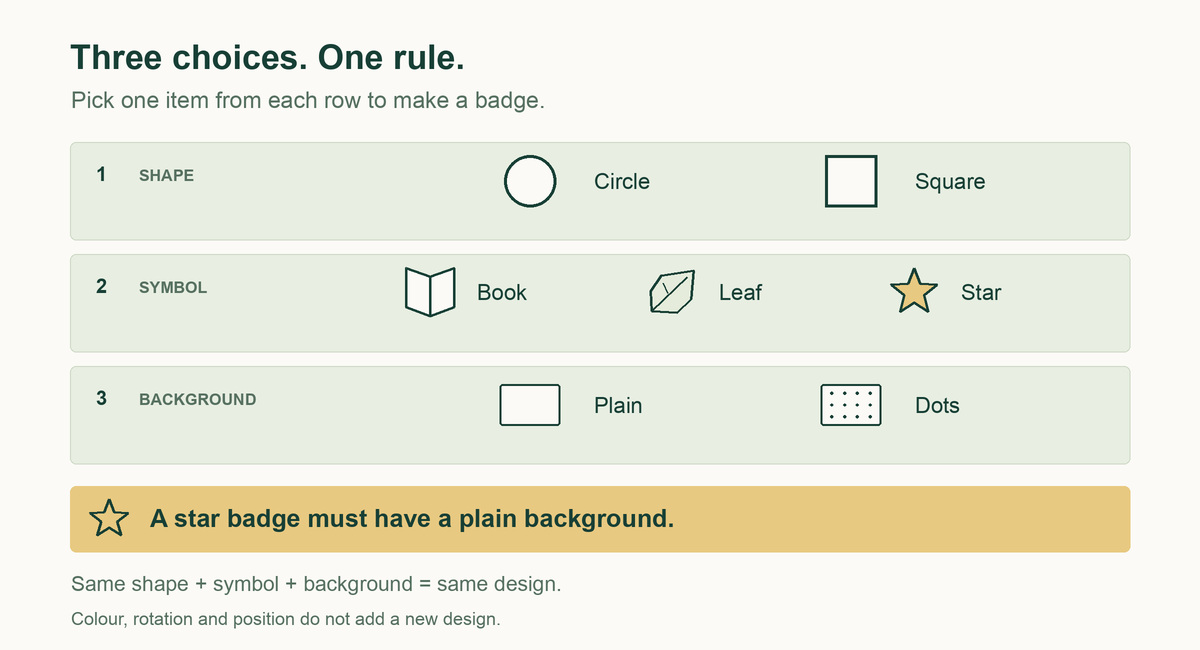
The factory rule: a star must have a plain background. This applies to both shapes. Two badges with the same shape, symbol and background count as the same design. Changing their colour, position or rotation does not make a new design.
Ask partners to sketch a circle/book/dots badge. Then offer square/star/dots as a new order. “Would the factory accept it? Which rule decides?” Let children explain before starting the main challenge.
Inspect the dispatch list
Copy or display this list exactly as it stands. One partner reads the choices; the other draws or labels a card for each row. Swap roles halfway through. Ask: “Are ten rows enough to prove we have ten different designs?”
| Row | Shape | Centre | Background |
|---|---|---|---|
| 1 | Circle | Book | Plain |
| 2 | Circle | Book | Dots |
| 3 | Circle | Leaf | Plain |
| 4 | Circle | Star | Plain |
| 5 | Square | Book | Plain |
| 6 | Square | Book | Dots |
| 7 | Square | Leaf | Plain |
| 8 | Square | Leaf | Dots |
| 9 | Square | Star | Plain |
| 10 | Square | Book | Dots |
Give pairs a few quiet minutes to investigate. They should mark a repeated design, find a permitted design that is missing, and repair the list. Ask them to keep evidence of their change: cross out the repeated row and write the replacement beside it.
If a pair gets stuck, ask them to put all circle badges together, then all square badges. Within each group, place matching centre symbols together. “Does every centre have every background it is allowed?” This question helps without naming the missing badge.
Build a procedure you can trust
A lucky discovery fixes one order. A reliable method helps with the next one. Invite pairs to turn their grouping into instructions. For example:
- Choose the circle. Keep that shape fixed while working through the centres.
- Choose the book. Make its plain badge, then its dotted badge. Do the same for the leaf.
- Choose the star. Make only its plain badge, because the rule excludes dots.
- Repeat for the square. Check each finished group for repeated or missing combinations.
Swap instructions with another pair. Can the new pair follow them without guessing? Ask the writers to improve any unclear step. Introduce algorithm as a sequence of instructions and debugging as finding and fixing a mistake. Here, children can test both ideas with paper.
Teacher check: the repair and the complete set
The original list has ten rows but nine different designs. Rows 6 and 10 both say square/book/dots. The missing design is circle/leaf/dots. Replace row 10 with that design. Every original row obeys the star rule; the problem is duplication and omission.
| Shape | All permitted centre/background pairs |
|---|---|
| Circle | Book/plain; book/dots; leaf/plain; leaf/dots; star/plain |
| Square | Book/plain; book/dots; leaf/plain; leaf/dots; star/plain |
Each shape has two book choices, two leaf choices and one star choice: five designs. Two shapes give ten distinct permitted designs. The organised groups show why none is missing or repeated. Counting ten rows alone cannot show this.
Listen for the explanation
Keep three questions in view: Does every badge follow the rule? Is each design different? Have we included every possibility? A child who finds the duplicate may still need help proving completeness. Ask them to point to the groups and explain how their method covers every choice.
Use large labelled cards, raised outlines or an oral description where helpful. Partners can move cards on request. Accept explanations in a familiar language before connecting them with choice, constraint and repeat. Colour and drawing skill should not decide success.
Change one rule; test the method again
For an exit challenge, replace the rule: leaf badges may be plain or dotted; book and star badges must be plain. Ask each child which existing designs disappear and how many remain. The two book/dots designs disappear, leaving eight: four for each shape. Listen for the reason alongside the number.
The task connects with competency C-3 for Classes 3–5 in CBSE’s CT and AI curriculum: systematically listing possibilities under a constraint. Its Class 4 Teacher Handbook, PDF pages 7–9, supports reasoning with conditions, counting instructions and discussion. The badge puzzle is an original classroom task.
Try another route into the topic: explore our CT and AI classroom starter. For staff considering digital tools, the responsible AI checklist takes the discussion further. What would convince your factory manager that an order is complete?
AI assistance was used to finalize this contribution. The views expressed are personal views of the author; official statements are identified through linked official sources.
Leave a Reply