
In this guide
A child builds 34 with three bundles and four loose sticks. You open one bundle. “Has the number changed?” That small surprise can turn a place-value lesson into a conversation worth having.
Try it in Class 2: allow about 25 minutes, working in pairs. Children build a two-digit number, exchange one ten for ten ones, and explain why the total stays the same. You need large counting sticks or reusable paper strips, bands and a two-column mat labelled Tens and Ones.
Give “ten” something children can hold
Start with objects children can count accurately, one at a time. Give each pair 44 sticks or strips, keeping ten aside for later. Use the remaining 34 to make groups of ten and fasten each group together. Each bundle must contain exactly ten. Let a partner open and check one before rebuilding it.
If counting 34 objects is still demanding, work together with 14 first. Keep the number small enough for children to check it themselves. Large pieces, a tray with a raised edge or a partner who moves objects on request can make the same mathematical task easier to access.
This activity connects with the NCF-FS place-value competency C-8.5: understanding how two-digit numerals represent quantities. NCERT’s Class 2 Joyful Mathematics teaching approach moves between objects, pictures and symbols, with games and talk that make children’s thinking visible. The sequence below is an original classroom activity built around that approach.
Build 34, then change its appearance
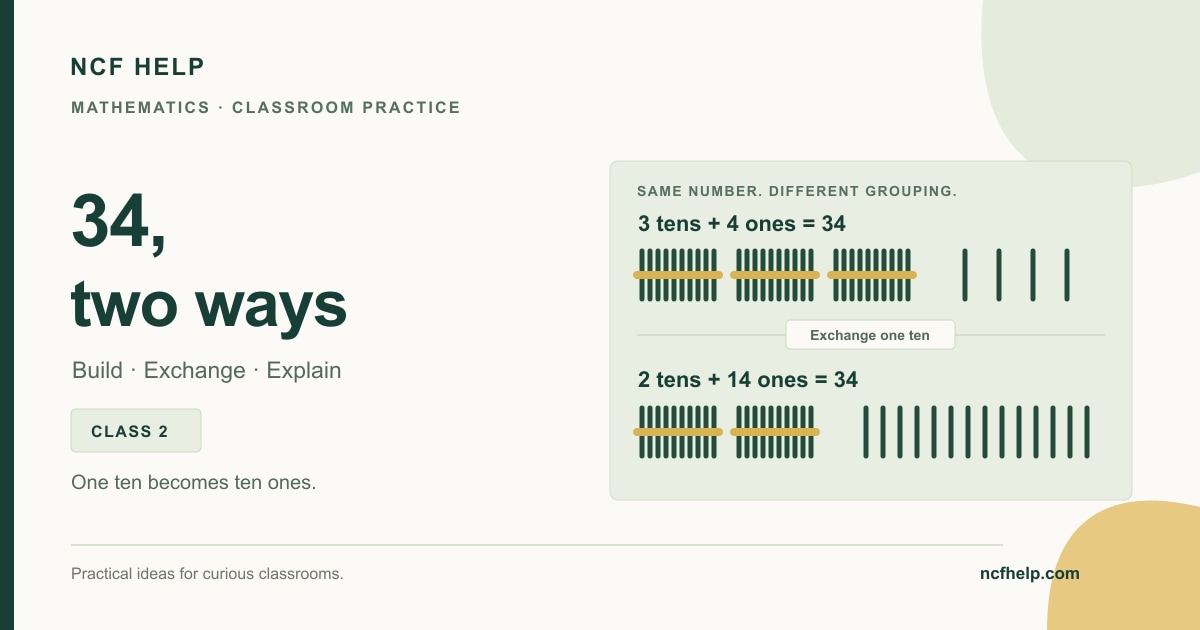
- Build and describe. Place three bundles in the Tens column and four loose sticks in Ones. Ask, “How many altogether? How do the bundles help you know?” Record 34 = 30 + 4 beside the mat.
- Make a prediction. Point to one bundle: “If we open this, will there be more sticks, fewer sticks or the same number?” Let partners explain before touching it.
- Exchange and check. Open one bundle and move its ten sticks to Ones. There are now two bundles and fourteen loose sticks. Nothing has been added or taken away. Count or regroup to check: 34 = 20 + 14.
- Swap roles. The second partner bundles ten loose sticks again. Ask them to explain both arrangements, then draw the two ways in their notebook.
Keep a useful distinction clear: 2 tens and 14 ones is a way of building 34. It does not mean writing 214. The numeral 34 uses the regrouped form with three tens and four ones; the exchange helps explain what those places mean.
Listen for reasoning, then choose the next move
A correct numeral is a useful start. The explanation tells you more. Use these prompts while moving between pairs; there is no need to score every response.
| What you notice | A helpful question | What to try next |
|---|---|---|
| The child counts each bundle as one object and says “seven”. | “How many sticks are inside this bundle?” | Open one, count its ten sticks, then rebuild and count 10, 20, 30, 31, 32, 33, 34. |
| The child thinks opening a bundle makes the total bigger. | “Did we bring in any new sticks?” | Match the opened sticks to the same bundle, then regroup to check the total. |
| The child explains both arrangements confidently. | “Can you build 34 a third way?” | Try one ten and 24 ones, and explain 34 = 10 + 24. |
Make room for mathematical talk. Accept an explanation through pointing, drawing or a familiar language. Offer the sentence frame “The total is still ___ because ___.” Then help children connect their explanation with the words ten, ones and exchange.
Let 29 become 30
Once the exchange makes sense, ask pairs to build 29: two tens and nine ones. Add one loose stick. “What can we bundle now?” Ten loose ones become a third ten, leaving no loose ones. Write 29 + 1 = 30, and connect the zero in 30 with the empty Ones column in this regrouped arrangement.
Now show 34 and 43. Ask children to build 34 and draw it, then reuse the sticks, adding spares as needed, to build 43. Compare the two drawings. Four tens make 43 greater than 34, even though 34 has more loose ones. Invite children to explain why looking only at the ones can lead to the wrong choice.
Finish with one small piece of evidence
Give each child a fresh number such as 26. Ask for a drawing and one explanation: “Show 26 in two ways. Tell me what stayed the same.” Two tens and six ones, or one ten and sixteen ones, both work. A child can explain orally while you note the idea in a few words.
Use that response to plan tomorrow: more counting and bundling, another exchange, or a comparison of two numbers. For children ready to explore number patterns, NCERT’s Fun with Numbers, Chapter 3, offers number-chart work that extends the conversation to one more and ten more.
Keep the learning going: fit this activity into a play-based weekly plan, or explore the wider questions in The Power of Mathematical Thinking. Which explanation would convince your partner that an opened bundle has not changed the number?
AI assistance was used to finalize this contribution. The views expressed are personal views of the author; official statements are identified through linked official sources.
Leave a Reply