
In this guide
For science teachers of Classes 6–8. Especially useful alongside Grade 7 work on light and shadows.
Can a five-centimetre card cast a shadow more than twice its width? A torch, a paper screen and a ruler turn that question into an investigation. Pupils predict, measure, compare and explain—and discover why a convincing answer needs more than “I saw it happen.”
At a glance
- Question: How does moving the torch change a shadow’s width when the card and screen stay fixed?
- Materials: a battery-powered LED torch, an opaque card, paper screen, ruler, tape and simple stands.
- Learning: change one factor, record repeated measurements and support an explanation with evidence.
Begin with a surprising shadow
Show the same card casting two different-sized shadows. Ask pupils what changed and what stayed the same. Collect predictions before explaining the pattern. “The card got bigger” is a useful starting idea: measure the card itself and invite pupils to reconsider.
NCERT’s Grade 7 Curiosity chapter on light explores shadow formation and how positions of the light source, object and screen affect it. This investigation builds on that idea with a measurable question. Its repeated readings and table are a classroom adaptation.
Build a setup you can trust
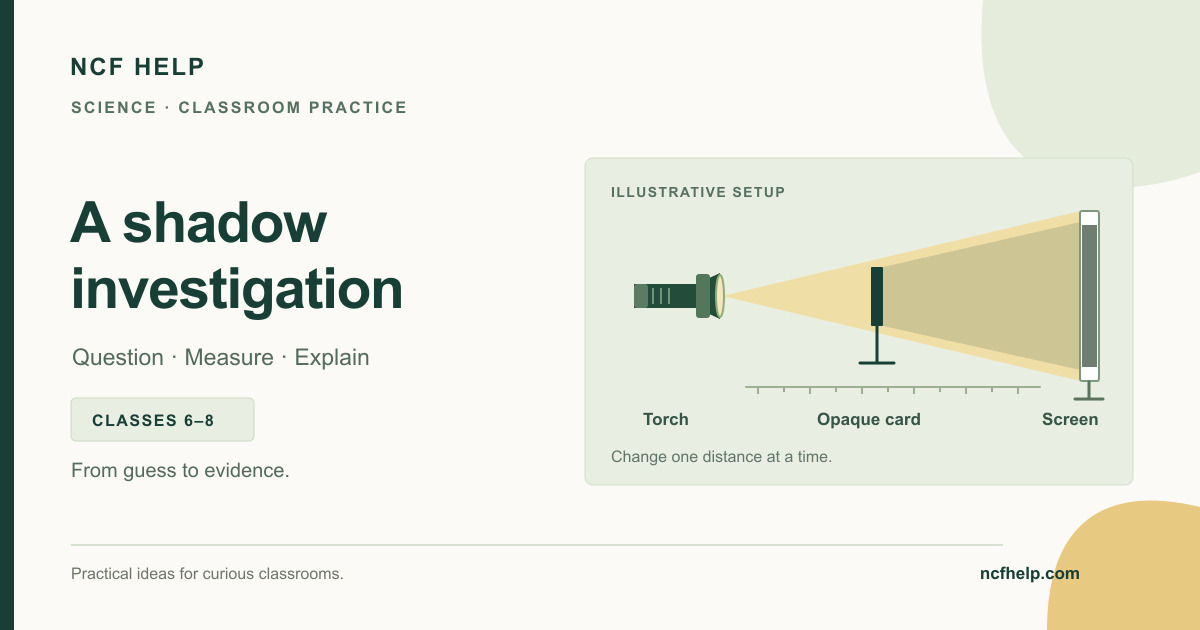
- Fix a white paper screen upright. Place an opaque rectangular card 5 cm wide in front of it, with the card and screen parallel.
- Set the card-to-screen gap at 30 cm. Secure both so that they remain in the same positions throughout. Mark their positions with tape.
- Place the torch behind the card, aimed at its centre. Support it so that its height and direction stay steady when moved. Measure the torch-to-card distance from the same point on the torch each time.
- Mark torch positions 20, 30, 40 and 50 cm from the card. Check that the shadow fits on the screen. Keep the beam directed at the screen and away from eyes.
The torch moves; the card and screen do not. Use the same card, torch and measuring line throughout. A single LED torch gives a clearer investigation than several light sources shining from different directions.
Try before class: test the four positions and choose a room where the shadow is visible. Measure its width at the same horizontal line each time. If an edge is blurred, agree how pupils will locate it and use that method consistently.
Predict, measure, then repeat
Before switching on the torch, ask: Will its shadow become wider or narrower as the torch moves farther from the card? Let each pupil give a reason. Rotate positioning, measuring and recording roles so everyone participates.
At each position, take three width readings. Realign the torch and check the measurement between readings; do not simply copy the first number. Record centimetres. NCERT’s Grade 6 measurement chapter explains ruler placement, eye position and units—use these habits here.
Fictional example data: use these readings to practise interpreting a table before collecting your own.
| Torch to card (cm) | Width 1 (cm) | Width 2 (cm) | Width 3 (cm) | Mean width (cm) |
|---|---|---|---|---|
| 20 | 12.4 | 12.5 | 12.6 | 12.5 |
| 30 | 9.9 | 10.0 | 10.1 | 10.0 |
| 40 | 8.7 | 8.8 | 8.9 | 8.8 |
| 50 | 7.9 | 8.0 | 8.1 | 8.0 |
For the first row, the mean is (12.4 + 12.5 + 12.6) ÷ 3 = 12.5 cm. Use means where this calculation has been taught; otherwise compare the three readings and describe their small spread.
Make the evidence do the explaining
In this table, increasing the torch-to-card distance from 20 to 50 cm reduces the mean shadow width from 12.5 to 8.0 cm—a 4.5 cm difference. The card remains 5 cm wide. The changing shadow comes from the changed positions, not a growing or shrinking card.
Light blocked by the card leaves a shadow on the screen. With this arrangement, moving the light farther back makes the shadow smaller. Ask pupils to connect that explanation with two readings and a labelled drawing showing the torch, card and screen.
The same 10 cm torch movement does not produce the same change each time. Avoid claiming that doubling a distance always halves a shadow. Invite a prediction for a new position, such as 25 cm, then test it rather than treating a guess as another measurement.
Give feedback that opens the next question
- Setup: Are the fixed positions clear? If the screen moved, help the pupil rebuild the comparison.
- Measurement: Are readings repeated and units included? If not, revisit one position together.
- Explanation: Does the answer use data and describe what changed? Ask “Which two readings support your claim?”
A helpful response might be: “You used the 20 cm and 50 cm rows to describe the change. Now explain why keeping the screen fixed matters.” Give time for revision. The task-and-rubric guide offers a wider assessment routine.
Keep every learner in the investigation
Use large position labels and a high-contrast screen. Provide a ready-drawn setup for pupils who need it. An oral explanation, labelled diagram or dictated response can show the science when writing fluency is not the learning goal. Let pupils compare the table even when they cannot operate the apparatus independently.
Finish with evidence-based self-assessment: “What did I keep fixed? Which reading helped my explanation? What would I check next?” Keep the discussion tied to what the pupil actually did.
Connect the activity with the bigger picture
NCERT’s description of Middle Stage learning connects observation and data collection with subject-specific inquiry. This small investigation makes that approach practical: a question, a controlled comparison and an explanation. Explore NCF Part C: School Subjects for the wider framework.
AI assistance was used to finalize this contribution. The views expressed are personal views of the author; official statements are identified through linked official sources.
Leave a Reply